Company registration in Africa continues to attract global attention as governments implement reforms that make it easier to start and operate a business. From tax incentives to investment protection, the continent is opening its doors to both local and foreign entrepreneurs.
This article explains everything you need to know—from business structures and requirements to the benefits and step-by-step process. Whether you’re a startup founder, corporate investor, or small business owner, this guide provides the key insights to help you with business registration in Africa.
Here’s a quick overview of registering a company in Africa, designed to simplify the remote registration process for potential investors.
The Economy of Africa
According to Wikipedia, Africa’s economy is built on its vast resources, diverse industries, and a population of over 1.3 billion people across 54 countries. Although historically affected by colonization and political instability, the continent has shown strong growth driven by manufacturing, services, commodities, and increased trade. Many regions—especially West, East, Central, and Southern Africa—are projected to reach a combined GDP of $29 trillion by 2050.
While Africa was once considered the poorest inhabited continent, the World Bank projects that most African nations could achieve middle-income status by 2025 if growth continues. Over the past decade, Africa has consistently ranked among the world’s fastest-growing regions, with many countries recording annual growth rates between 4% and 6% or higher. International analysts increasingly view Africa as a key driver of future global economic expansion, a vision reinforced by the African Union’s Agenda 2063, which aims to strengthen economic integration across the continent.
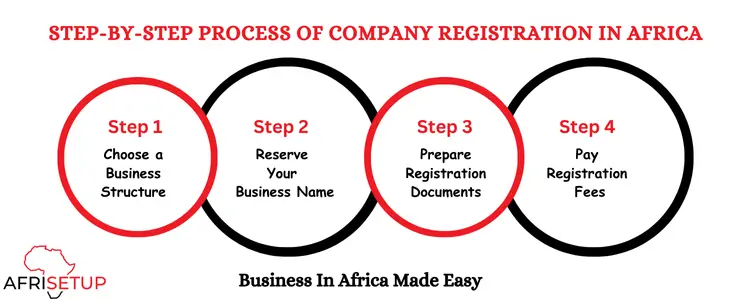
Step-by-Step Process of Company Registration in Africa
Business registration in Africa is a straightforward process when you understand the required steps. While procedures differ slightly from one country to another, the core stages remain similar across the continent.
1. Choose a Business Structure
Decide whether you want to operate as a sole proprietor, partnership, limited liability company (LLC), or another legal entity. Each option comes with its own requirements and level of liability protection.
2. Reserve Your Business Name
Select a unique business name and submit it for reservation. Many countries provide online platforms where you can quickly check availability and secure the name.
3. Prepare Registration Documents
Gather all necessary documents, such as a business description, details of directors or shareholders, and—where applicable—a memorandum or articles of association.
4. Pay Registration Fees
Settle all required government fees, including registration charges and stamp duty. These costs differ depending on the country and business structure you choose.
At Afrisetup, we follow these steps to ensure a smooth company setup in Africa.
Post-Registration Requirements for Company Registration in Africa
a. Banking and Tax Compliance
After completing the company registration process, businesses should immediately begin setting up corporate banking arrangements. This includes preparing Know Your Customer (KYC) documentation, confirming company signatories, and coordinating with the chosen financial institution.
At the same time, the company should apply for all relevant tax registrations, including Tax Identification Numbers (TIN), Value Added Tax (VAT) where applicable, and payroll-related registrations. These requirements are essential because company incorporation alone does not automatically authorize a business to operate legally within many African jurisdictions.
b. Employment and Operational Setup
Companies intending to hire employees must establish compliant employment structures as soon as operations begin. This includes preparing employment contracts, implementing payroll systems, and setting up employee benefits in accordance with local labour laws.
Businesses expanding quickly into African markets may also consider Employer of Record (EOR) services to support compliant hiring while the company finalizes its operational setup.
Key Requirements for Business Registration in Africa
While requirements differ by country, most African nations require:
• Proposed company name(s)
• Passport copies or national IDs
• Passport photos of directors
• Physical or virtual office address
• Memorandum & Articles of Association
• Details of shareholders
• Tax registration documents
At Afrisetup, we have simplified the process of company registration in Africa, making it smooth and efficient. Contact us to learn the specific requirements needed to register a company in any African country.
Local and Foreign Ownership Policies
Many African countries allow 100% foreign ownership, especially in sectors like retail, consultancy, ICT, import/export, and manufacturing. Some countries, such as Tanzania and Ethiopia, have restrictions for strategic sectors.
Benefits of Registering a Company in Africa
Business registration in Africa has a lot of benefits.
1. Access to Rapidly Growing Markets
Many African countries have fast-expanding populations and rising consumer demand. Registering locally helps businesses tap into huge market opportunities.
2. Legal Protection and Credibility
A registered company gains legal recognition, protects the business name, and builds trust with customers, partners, and investors.
3. Easier Access to Funding
Banks, investors, and development programs prefer dealing with formally registered companies. This improves your chances of getting loans or investments.
4. Eligibility for Government Incentives
Many African governments offer tax breaks, grants, and investment incentives to attract entrepreneurs and foreign investors.
5. Ability to Sign Contracts Legally
Registered companies can enter into official agreements, apply for tenders, and work with bigger organizations or government departments.
6. Limited Liability Protection
Structures like LLCs protect the owners’ personal assets. If the business faces challenges, personal belongings are not at risk.
7. Better Expansion Opportunities
With proper registration, it’s easier to open branches, bring in partners, import goods, or export to other markets.
8. Access to Regional Trade Blocs
Registering in Africa opens doors to large trade areas like the African Continental Free Trade Area (AfCFTA), EAC, ECOWAS, SADC, and more.
Factors That Commonly Delay Business Registration in Africa
Many investors assume that obtaining a certificate of incorporation marks the completion of the business setup process. In reality, becoming fully operational often depends on several additional procedures running alongside the registration process.
- Corporate banking requirements: Opening a business bank account can take longer than expected due to compliance checks. Financial institutions may request detailed KYC documentation, proof of address, and the physical presence of company signatories before approving the account.
- Tax compliance procedures: In many African jurisdictions, businesses must secure tax registration numbers before they can invoice clients, process salaries, or begin certain commercial activities. These registrations may involve additional paperwork and compliance obligations.
- Registered office and governance obligations: Certain countries require companies to maintain a local registered address, appoint resident directors, or engage a company secretary as part of ongoing compliance requirements.
- Industry-specific licensing: Businesses operating in regulated industries such as finance, telecommunications, mining, healthcare, or energy may need extra permits and approvals before commencing operations. These regulatory processes can significantly increase setup timelines.
For this reason, company registration in Africa should be treated as a broader business establishment process rather than a single administrative procedure.Contact Afrisetup for professional assistance!
How Afrisetup Helps You Register a Company in Africa
When it comes to company registration in Africa, we provide comprehensive assistance, including:
1. Name Reservation
Afrisetup handles the process of checking availability and reserving your preferred business name with the relevant authorities.
2. Drafting Incorporation Documents
They prepare all the required legal documents—such as incorporation forms, company statutes, and shareholder agreements—ensuring accuracy and compliance with local laws.
3. Tax Registration
Afrisetup assists with obtaining essential tax documents, including tax identification numbers (TINs), VAT registration, and other statutory tax requirements.
4. Opening Bank Accounts
They guide you through the process of opening corporate bank accounts, working with trusted local and international banks to simplify the procedure.
5. Obtaining Local Permits
Afrisetup helps secure any licenses or permits specific to your industry—whether you’re in construction, import/export, security services, manufacturing, or any regulated sector.
6. Trademark Registration
To protect your brand, they assist with registering trademarks across various African jurisdictions.
7. HR & Payroll Support
Afrisetup offers ongoing support with employee hiring, payroll management, statutory compliance, and HR documentation.
With years of experience helping foreign investors enter Africa, Afrisetup ensures a smooth, compliant, and fast process.
Conclusion
Company registration in Africa offers massive opportunities for entrepreneurs and investors who are ready to tap into a rapidly growing market. With strategic reforms, investor-friendly laws, and expanding regional trade blocs, Africa has become one of the best destinations for business expansion.
Whether you’re starting in Kenya, Uganda, Rwanda, or anywhere across the continent, understanding the process and working with experts like Afrisetup ensures a fast, smooth, and compliant registration.