

Company registration in Egypt is the essential first step for anyone looking to establish a business in one of the region’s most dynamic markets. Egypt is a thriving business hub, offering lucrative opportunities for both local and foreign investors. Whether your goal is to tap into the country’s growing domestic market or expand your international presence, registering a company here opens the door to countless possibilities. With its strategic location connecting Africa, the Middle East, and Europe, along with investor-friendly regulations, Egypt provides an ideal environment for starting and growing a business.
Interested in company incorporation in Egypt? Watch this video to learn how to register a company in Egypt quickly and easily.
Egypt Company Registry
In Egypt, the General Authority for Investment and Free Zones (GAFI) is the primary government body responsible for company registration and business incorporation. All businesses operating legally in Egypt must be registered with the Egyptian Commercial Registry, which GAFI oversees.
Egypt Company Register Search
If you need to search for a registered company in Egypt, you can do so through GAFI, which manages the official company registry. For those looking to incorporate a business in Egypt, GAFI provides a convenient online e-portal that offers:
• Online company registration services
• Secure payment options using e-signatures
• Application tracking for incorporation status
• Comprehensive details on legal structures, required documents, fees, and processing times
How to Check Company Registration in Egypt
You can use official Egyptian government platforms to verify a company’s registration status and access essential business information. The two primary websites for this are:
• Digital Egypt – Provides access to business-related information, including the commercial registry.
• Ministry of Trade and Industry – Offers company registration details through its commercial registry section.
Here is the process:
1. Visit the Digital Egypt or the Ministry of Trade and Industry website.
2. Enter the company’s registration or tax number to retrieve its commercial register details.
3. Filter the search by selecting the company type and location in Egypt.
Types of Companies in Egypt
Understanding the different types of companies available in Egypt is crucial for choosing the right structure for your business. Under Egypt’s Companies Law (Law No. 159 of 1981), as amended, several legally recognized business forms are available to both local and foreign investors, and each option offers unique advantages tailored to various business needs and objectives.
1. Limited Liability Company (LLC) – (Arabic: Sharikat El-Mahdud el-Mas’oulia)
An LLC in Egypt allows for up to 100% foreign ownership. It must be owned by at least two partners and may have up to 50 partners (individuals or legal entities). Shareholders are only liable for their shares. Partners’ liability is limited to their capital contributions.
There is generally no statutory minimum capital requirement under Law 159 (unless imposed by a regulated sector), and capital is freely determined by the partners. The company is managed by one or more managers, who may be Egyptian or foreign nationals, subject to sector-specific restrictions.
Shares and bonds are not negotiable, and LLCs cannot list on the stock exchange or offer shares to the public, making them a popular structure for small and medium-sized enterprises (SMEs) and joint ventures.
2. Joint Stock Company (JSC) – (Arabic: Sharikat El-Amanah)
A JSC in Egypt requires at least three shareholders, who may be individuals or legal entities. Shareholders’ liability is limited to the value of their shares. The minimum issued capital is EGP 250,000, divided into equal shares.
After registration of a company in Egypt, JSCs may raise capital through public subscription and can be listed on the Egyptian Exchange (EGX), making this structure ideal for businesses seeking to attract investors or undertake large-scale projects.
A JSC must be managed by a board of directors consisting of at least three members. At incorporation, 10% of the capital must be deposited (25% within three months, with the remaining balance payable within five years). Foreign investors may generally own up to 100% of the shares, except in restricted sectors.
3. General Partnership – (Arabic: Sherikat Odawiya)
A general partnership involves at least two active partners, all of whom participate in management. Each partner has joint and several (unlimited) liability for the partnership’s debts and obligations.
There is no minimum capital requirement by law. While the partnership is registered with the Commercial Registry, it does not have a legal personality separate from its partners. Due to unlimited liability, general partnerships are less commonly used by foreign investors, but they remain suitable for small businesses and professional practices.
4. Limited Partnership – (Arabic: Sherikat Mahdudah)
In a limited partnership, at least one general partner has unlimited liability and manages the business, while one or more limited partners contribute capital and have liability limited to their contributions. Limited partners may not participate in management.
There is no statutory minimum capital requirement, and capital contributions are agreed upon by the partners. Like general partnerships, limited partnerships lack separate corporate legal personality, but they offer flexibility by allowing passive investors. Under certain conditions, they may be converted into a joint stock company.
5. One-Person Company (OPC)
Introduced by amendment in 2018, an OPC allows a single individual or legal entity to own 100% of the company’s capital, while benefiting from limited liability. For Company registration in Egypt, the minimum capital requirement is EGP 1,000, which must be fully paid upon incorporation.
The sole owner’s liability is limited to the company capital. OPCs are prohibited from issuing tradable securities, borrowing through public offerings, or engaging in banking, insurance, savings, or investment fund activities.
An OPC must appoint a registered legal advisor and an external auditor. This structure combines the simplicity of sole ownership with corporate liability protection and is ideal for solo entrepreneurs and startups.
6. Branch Office of a Foreign Company
A foreign company may establish a branch in Egypt under Companies Law No. 159 of 1981. A branch is not a separate legal entity from its parent company and is typically established to perform specific contracts or projects in Egypt.
Registration is completed with the General Authority for Investment and Free Zones (GAFI). The minimum capital requirement is EGP 5,000, largely a formality. The parent company must submit certified incorporation documents, board resolutions, and appoint a branch manager.
Branches are taxed in Egypt on locally generated income. In certain cases, branches operating in new development areas and employing Egyptian nationals may benefit from tax incentives or exemptions, subject to applicable investment laws.
N/B- In Egypt, there is no fixed minimum capital requirement for setting up a Limited Liability Company (LLC). This means partners are free to decide how much capital they wish to invest. However, certain industries—such as import, export, or financial services—may have higher capital requirements based on licensing regulations. For most businesses, even a small amount of capital is enough to get started, making the LLC a flexible and appealing option for new entrepreneurs.
Procedure for Company Registration in Egypt
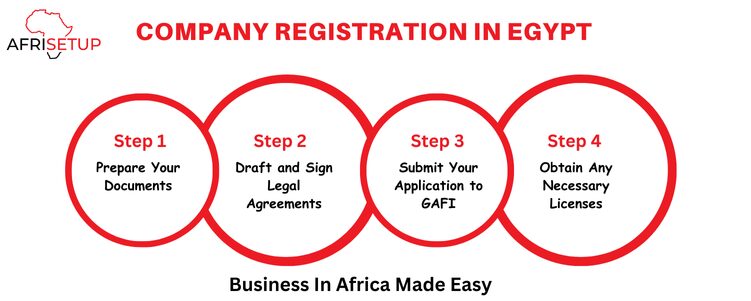
Mastering company formation in Egypt is vital for ensuring legal compliance and driving business success. This comprehensive guide will take you through the key steps and requirements to successfully register your business in Egypt. Let’s dive into the process:
Step 1: Reserve a Trade Name
Propose at least 3 preferred company names and submit them for approval through GAFI’s online system or the Commercial Registry for verification. Once approved, you will receive a non-confusion certificate confirming the name is distinct and not already in use.
Step 2: Prepare Your Documents
Before you register a company in Egypt, make sure you have all the necessary documents ready. These typically include:
• Passports or IDs of all shareholders
• Postal, physical and e-mail address, telephone number and occupation of all Shareholders/directors of the proposed company
• Proposed company name
• Proof of residence (utility bill, rental agreement, etc.)
• Initial capital deposit (if applicable)
• Power of attorney from the Parent Company. (We will draft the POA bilingual “English and Arabic”.
• Share Apportionment percentage
N/B- If the company is owned by a parent company, you will also need to provide the parent company’s certificate of incorporation, translated into Arabic. Having these documents in order will make the next step for company registration in Egypt smoother and faster.
Step 3: Draft and Sign Legal Agreements
In this step, you will need to work with a legal team to draft two key documents, which must be translated into Arabic.
• Memorandum of Association (MOA): This outlines the company’s purpose, operations, and structure.
• Articles of Association (AOA): This sets the operational guidelines for the company.
Once the documents are prepared, all shareholders must sign them to proceed.
Step 4: Submit Your Application to GAFI
Submit your company registration application to the General Authority for Investment and Free Zones (GAFI). Once all requirements are met, GAFI will review it and approve it.
Step 5: Obtain Any Necessary Licenses
After GAFI approves your registration, you’ll need to acquire:
• Tax Identification Number (TIN): Like every individual, your business needs an ID number. Get a TIN from the Egyptian Tax Authority to keep things legal.
• VAT Registration: If your business sells goods or services subject to VAT, you must register for VAT. It’s a must to stay compliant.
• Industry-Specific Permits and Licenses: Depending on your business, you may need extra permits or licenses to operate legally. Think of it as the special permissions necessary for specific industries.
• Register with the Social Insurance Office: This ensures your employees are covered under Egypt’s social insurance system.
• Register with the Commercial Registry: This finalizes your company’s legal status as a registered business in Egypt.
• Issue Share Certificates: Provide official share certificates to all shareholders.
• Maintain Statutory Books and Records: Keep accurate company records as required by law.
• Follow Employment Regulations: Ensure compliance with local labor laws for contracts, wages, and working conditions.
• File Annual Financial Statements: Submit yearly financial reports to the relevant authorities.
• File Tax Returns and Pay Taxes: Stay up to date with all tax filings and payments.
• Apply for Work Permits (if needed): If you hire foreign staff, secure work permits for them.
Timeline for Registering a Company in Egypt
Company registration in Egypt typically takes 3–4 weeks for an LLC or JSC, provided all required documents are complete and correctly filed. Recent reforms have streamlined the process, making registration faster and more efficient.
A general timeline looks like this:
• Name reservation: 1–2 days
• Document preparation and notarization: 1–2 weeks
• GAFI approval: 1–5 working days
• Commercial and tax registration: 1–2 weeks
On average, businesses should plan for about 3 weeks to finalize the process of Egypt company registration. The exact timeframe can vary depending on factors like company structure, foreign ownership, and any additional licenses required for specific activities.
8 Compelling Reasons to Establish Your Business in Egypt
Here are top reasons why you should register a company in Egypt:
1. Strategic Location: Gateway to Africa, Europe, and the Middle East.
2. Growing Economy: One of the fastest-growing economies in Africa.
3. Investment Incentives: Government initiatives and tax benefits for businesses.
4. Large Consumer Market: Over 100 million potential customers.
5. Infrastructure development: Continuous improvements in infrastructure and a strong focus on diversifying the economy.
6. Skilled Workforce: Access to a young and dynamic workforce, providing a solid labor pool and a growing market for goods and services.
7. Special Economic Zones and Industrial Parks: Offering key advantages such as tax relief and customs incentives, significantly reducing operating expenses.
8. Supportive Business Environment: Egypt has a well-established regulatory framework to enhance business activities and stimulate economic development, positioning it as an attractive option for domestic and international investors.
Start your business in Egypt today. Let Afrisetup assist you with company registration in Egypt from the comfort of your home country.
Why Choose Afrisetup for Company Formation in Egypt
1. Expertise in Egyptian Business Laws
Afrisetup has in-depth knowledge of setup of limited liability company in Egypt, Egypt’s corporate laws and regulations. Our experts ensure your company complies with all legal requirements, avoiding unnecessary delays or penalties.
2. Fast and Hassle-Free Registration
We streamline the process for company registration in Egypt, efficiently handling paperwork, licensing, and approvals so you can start operations quickly without administrative burdens.
3. Comprehensive Business Support
Beyond business setup in Egypt, we provide tax advisory, accounting, and compliance services to help your business thrive in Egypt’s competitive market.
4. Tailored Solutions for Foreign Investors
We specialize in assisting foreign entrepreneurs by offering solutions for business structures, work permits, and tax optimization, making establishing a presence in Egypt easy.
5. Reliable and Transparent Services
With Afrisetup, you receive clear pricing, honest consultations, and dedicated support throughout the company formation journey, ensuring a smooth and trustworthy experience.
Frequently Asked Questions about Company Registration in Egypt
The registration fee with the General Authority for Investment and Free Zones (GAFI) typically ranges from $100 to $300, depending on the entity type. Additionally, while some business types have no minimum capital requirement, others, like LLCs, generally require an initial capital of $1,000 or more.
Visit the “Digital Egypt” website (di.gov.eg) or the Ministry of Trade and Industry website (mti.gov.eg). You can access the Commercial Registry and search for the company’s information on these sites.
A company’s registration in Egypt generally takes 2 to 4 weeks, but obtaining the required licenses or approvals may lengthen the timeline.
Egypt has positioned itself as a prime location for global business growth, offering a unique set of strategic benefits. Its expanding economy creates a dynamic market, with opportunities spanning multiple industries, such as technology, agriculture, tourism, and manufacturing.
The corporate income tax (CIT) rate in Egypt is 22.5% on businesses’ net taxable income. This rate applies to all business operations, except oil exploration companies, which are taxed at a higher rate of 40.55% on their profits.
The corporate income tax (CIT) rate in Egypt is 22.5% on businesses’ net taxable income. This rate applies to all business operations, except oil exploration companies, which are taxed at a higher rate of 40.55% on their profits.
In Egypt, the Limited Liability Company (LLC) is the most commonly chosen business structure for foreign investors. This type of company offers limited liability protection to its owners and a minimal share capital requirement. Foreign investors can fully own the LLC, holding 100% of its shares.
Yes, foreigners can start a business in Egypt. The government offers streamlined registration, low taxes, and financial incentives. However, some industries may require local partnerships, so it is best to seek legal advice.
Opening a bank account in Egypt is simple and accessible for both residents and non-residents. The country’s banking system is secure and properly regulated, providing a reliable environment for managing finances.
No, Egyptian law does not impose any nationality restrictions on the directors of a Joint Stock Company (JSC) or a Limited Liability Company (LLC).
No, Egyptian law does not require the directors of a Joint Stock Company (JSC) or a Limited Liability Company (LLC) to be residents of Egypt.
No, it is not mandatory. However, a secretary must be present at general assembly meetings and board of directors’ meetings.
Yes, foreign investors can fully own companies in Egypt. However, some sectors have ownership restrictions. For example, import-related businesses generally need at least 51% Egyptian ownership, although recent regulations allow companies that don’t meet this threshold to operate in import activities for up to 10 years. Other sectors, like commercial agencies and foreign exchange trading, are restricted to full Egyptian ownership.
Conclusion
Company registration in Egypt is a strategic move for investors looking to expand into Africa and the Middle East. Understanding legal requirements, taxation, and compliance ensures smooth operations. Entrepreneurs can successfully set up a business in Egypt by working with local experts and following proper procedures. Contact us today to get started.