

Company registration in Namibia is an essential first step for entrepreneurs and investors looking to tap into one of Southern Africa’s most promising markets. Namibia is rapidly emerging as a hotspot for foreign investment, thanks to its political stability, open economy, and investor-friendly legal framework. With a strategic location, a skilled workforce, and access to both African and international markets, the country offers an ideal environment for starting and growing a business. Whether you’re a local entrepreneur, a diaspora investor, or a multinational corporation, registering a company in Namibia can be your gateway to sustainable growth and regional expansion.
Before we begin, we recommend watching this video for a comprehensive, step-by-step guide on how to register a company in Namibia, from start to finish.
Economy of Namibia
Namibia has a mixed economy with a strong modern sector and a traditional subsistence base, supported by a skilled workforce and experienced professionals.
For investors, the country offers political stability, transparent governance, and a business-friendly environment. It has modern infrastructure, strategic access to regional markets through Walvis Bay, and abundant natural resources.
With opportunities in mining, energy, tourism, and agriculture—along with policies that support foreign ownership and profit repatriation—Namibia is an attractive destination for investment in Africa. Let us now dive in and guide you through the process of company registration in Namibia.
How to Register a Company in Namibia
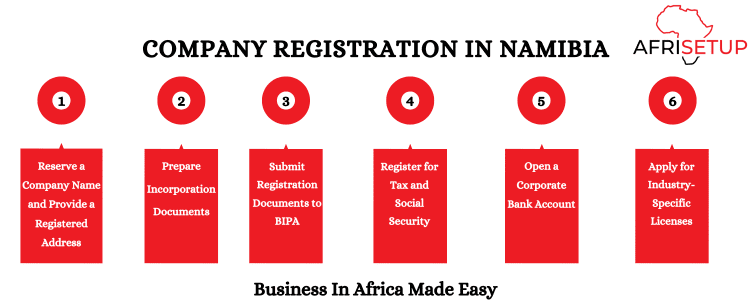
Through the Business and Intellectual Property Authority (BIPA), registering a company in Namibia has been streamlined. You can now do it online from the comfort of your home country by following these steps:
Step 1: Choose Your Business Structure
Before you file any paperwork, the first step of company registration in Namibia is decide which legal entity fits your goals. Here are some of the businesses you can register:
- Sole Proprietorship (Defensive Name): The simplest and cheapest setup for individuals. It offers no legal separation between the owner and the business.
- Private Company (Pty) Ltd: Best for scalable businesses and foreign investors. Allows 1–50 shareholders and limited liability.
- Close Corporation (CC): The “SME favorite.” Simplified for 1–10 members with lower admin costs and no board of directors required.
- Public Company (Ltd): For large-scale ventures. Minimum of 7 members; can invite the public to buy shares and list on the Namibian Stock Exchange (NSX).
- Non-Profit Association (Section 21 Company): Specifically for charitable or community goals. It operates without the intent to distribute profits to its members.
- External (Foreign) Company: A branch of a foreign-registered firm operating locally without forming a new Namibian subsidiary.
Step 2: Reserve a Company Name
Submit Form CM5 (for companies) or CC8 (for Close Corporations) to BIPA to reserve your proposed name.
When applying for a company name reservation, it is advisable to provide at least 3 to 6 optional names in order of preference.
N/B- When a name is approved, it will be reserved for 60 days.
Step 3: Prepare Incorporation Documents
For a Private Company (Pty) Ltd, the following documents must be submitted in triplicate:
- Memorandum and Articles of Association (CM2 & CM44): Notarized company constitution documents.
- Certificate of Incorporation (CM1): Official registration form.
- Notice of Registered Office (CM22): Company’s physical and postal address in Namibia.
- Directors and Officers Details (CM29): Information on company management.
- Auditor’s Consent (CM31): Written approval from a Namibian-registered auditor.
- Capital Adequacy Statement (CM47): Directors’ confirmation of sufficient funding.
- Beneficial Ownership Forms: Disclosure of all ultimate owners for compliance.
Step 4: Submit Registration Documents to BIPA
Submit the completed and signed incorporation documents to BIPA, either online or at their offices, and pay the required registration fees required for company registration in Namibia.
Once approved, BIPA will issue the Certificate of Incorporation, the Certificate to Commence Business, and assign a company registration number.
If you are establishing a business in Namibia as a foreigner, register it as an external company instead of forming a local entity. This requires submitting certified constitutional documents, details of appointed local representatives, and the address of the company’s principal place of business in Namibia.
NOTE: Typically, the process for company registration in Namibia takes between 10 to 25 working days. At Afrisetup, we make the processes for company registration inn Namibia simple.
Post-Registration Obligations to Start a Business in Namibia
After completing Company registration in Namibia, there are essential steps you must take to ensure compliance. These include:
1. Register for Tax
You must register with the Namibia Revenue Agency (NamRA) for income tax purposes. If your annual turnover exceeds NAD 500,000, you are required to register for VAT.
2. Register with Social Security Commission
In Namibia, all employers must register themselves and their employees with the Social Security Commission (SSC) within 14 days of starting business or hiring. Registration is mandatory for any business with at least one employee.
3. Open a Corporate Bank Account
With your business legally registered, you can open a business bank account in Namibia. Most banks will require your BIPA certificate and tax registration details.
4. Apply for Industry-Specific Licenses
Depending on the type of business you’re operating, you may need to obtain additional licenses or permits from relevant authorities. These could include trading licenses, environmental clearances, or sector-specific approvals.
Cost of Registering a Business in Namibia
The cost required to register a company in Namibia depends on several factors, including the type of company (e.g., Private Limited, Sole Proprietorship, or Close Corporation) and the specific registration package you choose.
For a detailed breakdown of the fees and to understand what’s included in each package, contact us today. We’ll guide you through the costs and help you choose the most suitable option for your business needs.
Key Requirements for Company Registration in Namibia
Here are the forms required for registering a company in Namibia:
- Name Reservation Form (CM5)– Used to apply for and reserve your company name.
- Application for Certificate of Incorporation– A formal request to legally register the company.
- Certificate to Commence Business (CM46)– Required before a business can begin operations.
- Memorandum and Articles of Association– Must be submitted in triplicate, with two copies certified by a Notary Public. Supporting forms include: CM2, CM44, CM44C,and a copy of the approved name reservation (CM5)
- Notice of Registered and Postal Address (CM22)– Indicates your official business address.
- List of Company Officials (CM29)– Includes details of directors, auditors, and public officers.
- • Auditor Appointment Form (CM31)– Designates your company’s official auditor.
- Directors’ Statement on Capital Adequacy (CM47)– Confirms the sufficiency of the company’s capital.
- Duplicate Submission Request (CM51)– Used when additional certified copies are required.
Benefits of Registering a Company in Namibia
Company registration in Namibia offers a wide range of advantages, including:
1. Legal Separation and Asset Protection
A registered company has its own legal identity, which protects the owners’ personal assets from business-related liabilities.
2. Enhanced Credibility
Customers, partners, and investors are more likely to trust and engage with a formally registered business. It adds professionalism and boosts your brand’s reputation.
3. Easier Access to Funding
Financial institutions and investors are more likely to fund registered businesses, as they are perceived as legitimate and well-structured entities.
4. Tax Incentives and Advantages
Depending on your business type and operations, you may qualify for various tax incentives offered to formal enterprises in Namibia.
5. Eligibility for Tenders and Contracts
Government agencies and large corporations often require businesses to be registered before awarding tenders or contracts.
6. Continuity and Longevity
A registered business continues to operate even if ownership or management changes, ensuring business continuity over time.
7. Access to Regional Markets
Registered businesses in Namibia can tap into regional trade opportunities through the Southern African Development Community (SADC), which comprises 15 member states.
8. Attracting Local and International Investors
Formal registration boosts your company’s appeal to investors who prioritize transparency, legal status, and long-term stability.
Company Registration in Namibia FAQs
- At least four proposed business names
- A brief description of your business activities
- A certified copy of your ID or passport
- A physical business address and PO Box in Namibia (a registered address can be provided if needed)
- Contact details: phone number and email of the company members
Yes, a foreigner can legally own a business in the country. After registering a company in Namibia, foreign directors or shareholders must apply for a work permit if they plan to live and work in the country.
Visit the BIPA website and use the online business search tool to verify company registration status.
A Pty Ltd (Private Limited) company in Namibia is a business with limited liability and privately held shares, restricted to a maximum of 50 shareholders.
A Section 21 company in Namibia is a non-profit organization registered under the Companies Act to operate for social, charitable, or community purposes rather than profit.
Yes, Namibia is considered a good place to do business due to its political stability, investor-friendly policies, reliable infrastructure, and strategic location within Southern Africa
BIPA stands for Business and Intellectual Property Authority. It is a government agency under the Ministry of Industrialization and Trade, responsible for registering businesses and managing intellectual property rights in Namibia.
To deregister a company in Namibia, submit the relevant deregistration form (Form CC1 for Close Corporations or Form 3.1 for Companies) to BIPA, along with proof that all debts and tax obligations have been cleared.
Conclusion
Company registration in Namibia is a strategic move for any investor targeting the Southern African region. With its stable economy, open-door policies, and attractive investor incentives, Namibia provides a fertile ground for business growth. Whether you’re going solo or partnering locally, having the right legal and administrative support is key.
Let Afrisetup handle the paperwork while you focus on building your dream venture.