
Company registration in Cameroon is the legal process of incorporating a business under the Organisation for the Harmonisation of Corporate Law in Africa (OHADA) Uniform Act and Cameroonian commercial law. Registering your company ensures compliance, legal protection, and operational legitimacy within Cameroon’s growing economy.
Whether you are a local entrepreneur, foreign investor, startup founder, or multinational expanding into Central Africa, business registration in Cameroon is essential for market entry, banking access, and government compliance.
This video explains the cost, timeline, required documents, and legal requirements for the procedure to register a business in Cameroon.
Why Invest in Cameroon?
Cameroon is one of Central Africa’s most strategic economies, often referred to as “Africa in miniature” due to its geographic and economic diversity. With access to both the West and Central African markets, the country serves as a gateway to the CEMAC region, offering businesses regional expansion opportunities beyond its domestic market.
According to the World Bank, Cameroon has maintained steady GDP growth in recent years, supported by infrastructure development, energy projects, agriculture, and services. The country is also a member of OHADA, which harmonizes business laws across 17 African countries — providing legal predictability and investor protection.
Types of Companies in Cameroon
Under the OHADA Uniform Act relating to Commercial Companies and Economic Interest Groups (AUSGIE), investors can choose from several legal structures when undertaking company registration in Cameroon. The type of company selected affects liability, governance, capital requirements, and operational flexibility.
Below are the main types of companies that can be incorporated in Cameroon:
1. Private Limited Company (SARL)
The Private Limited Company (Société à Responsabilité Limitée – SARL) is the most commonly used structure for company formation in Cameroon.
Shareholders are liable only up to the amount of their capital contributions. A SARL can be formed by one or more natural or legal persons, making it suitable for SMEs, startups, and foreign investors seeking limited liability and flexible management.
Contact us to help you register a private limited company today.
2. Public Limited Company (SA)
The Public Limited Company (Société Anonyme – SA) is designed for larger businesses and companies seeking to raise significant capital.
Shareholders’ liability is limited to the value of their shares. An SA may have a single shareholder and is permitted to make a public offering of shares, subject to regulatory compliance.
3. Simplified Public Limited Company (SAS)
The Simplified Public Limited Company (Société par Actions Simplifiée – SAS) offers greater contractual flexibility in structuring governance and operations.
Shareholders are liable only to the extent of their contributions. The Articles of Association define the management structure, subject to mandatory OHADA provisions. An SAS may also be formed by a single shareholder.
4. General Partnership (Private Unlimited Company)
In a General Partnership, all partners are considered traders and have unlimited joint and several liability for the company’s debts.
This structure carries higher risk because personal assets may be exposed in case of financial obligations.
5. Limited Partnership (Sleeping Partnership)
A Limited Partnership consists of:
- One or more active partners with unlimited liability
- One or more sleeping (limited) partners whose liability is restricted to their capital contributions
This structure combines managerial control by active partners with limited-risk investors.
6. Economic Interest Group (GIE)
An Economic Interest Group (Groupement d’Intérêt Économique – GIE) is formed to support and enhance the economic activities of its members rather than generate independent profit. It allows businesses to pool resources and collaborate while maintaining separate legal identities.
7. Joint Ventures and De Facto Partnerships
Cameroon law also recognizes companies without full corporate personality, such as:
- Joint ventures
- De facto partnerships
These structures are typically used for temporary projects or specific commercial arrangements.
8. Cooperative Society
A Cooperative is an autonomous entity formed to meet the common economic, social, or cultural needs of its members through collectively owned and democratically controlled operations.
For most investors considering business registration in Cameroon, the preferred structures are:
- Private Limited Company (SARL)
- Public Limited Company (SA)
- Simplified Public Limited Company (SAS)
These structures provide limited liability protection, clearer governance rules, and better suitability for foreign investors.
Choosing the right structure is a critical step in the company registration process in Cameroon, as it affects taxation, liability, compliance obligations, and long-term business strategy.
Requirements for Registering a Business in Cameroon
To complete company registration in Cameroon, the following information and documents are required:
1. Company Name: Provide at least two proposed names. A name search will be conducted to confirm availability.
2. Business Activities: State the main activities and objectives of the company.
3. Registered Office Address: Provide a physical address in Cameroon for official registration.
4. Share Capital: Declare the company’s share capital and how it will be shared among shareholders.
5. Director Details: Provide details of at least one director, including full name, address, and valid identification (passport or national ID).
6. Shareholder Information: Submit shareholder details including names, addresses, contact information, and identification documents. A shareholder can also be a director.
7. Articles of Association: Prepare and notarize the company’s Articles of Association in compliance with OHADA regulations.
8. Company Secretary or Legal Adviser (If Required): For a private limited company (SARL), this is optional. Some company types may require formal appointments.
Foreign shareholders may need notarized and legalized copies of identification documents. Meeting these requirements for registering a business in Cameroon ensures faster processing.
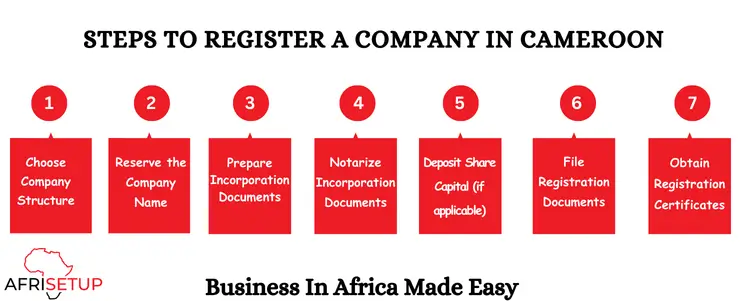
7 Steps to Register a Company in Cameroon
Understanding the procedure to register a business in Cameroon helps avoid delays and compliance risks.
Step 1: Choose Company Structure
Select the appropriate legal structure based on ownership, capital, liability, and business objectives. Options include SARL, SA, SAS, branch office, or other OHADA entities.
Step 2: Reserve the Company Name
Submit a proposed company name to the Trade and Personal Property Credit Register (RCCM) for availability verification and reservation.
Step 3: Prepare Incorporation Documents
Draft Articles of Association and shareholder resolutions in compliance with OHADA standards.
Step 4: Notarize Incorporation Documents
OHADA requires notarization of constitutional documents before filing.
Step 5: Deposit Share Capital (if applicable)
Deposit share capital into a temporary bank account and obtain a capital deposit certificate.
Step 6: File Registration Documents
Submit incorporation documents to the One-Stop Business Creation Center (CFCE) or relevant registry office for official registration. The CFCE coordinates; commercial registry entry, tax registration, statistical registration and social security enrollment.
Step 7: Obtain Registration Certificates
After incorporation, the company receives:
- Registration Certificate (RCCM Registration Certificate / Certificate of Incorporation)
- Taxpayer Identification Number (TIN / Numéro d’Identification Fiscale – NIF)
- Certificate of Company Creation (Attestation de Création d’Entreprise) with certified Articles of Association
This completes the company formation in Cameroon.
Post-Registration Requirements in Cameroon
After business registration in Cameroon, companies must complete tax registration and meet ongoing compliance obligations, including:
Tax Registration and Payroll Compliance
- Corporate income tax registration
- VAT registration (if turnover threshold is met)
- Payroll tax registration (if hiring employees)
- Social security contributions
Ongoing Compliance Obligations
- Maintain accounting records
- File annual financial statements and tax returns
- Renew sector-specific licenses (where applicable)
- Update registry records for any structural changes
Failure to comply with these requirements may result in penalties, suspension, or deregistration. Company formation in Cameroon generally takes 2 to 5 weeks, including legal, tax, and administrative procedures. Where documentation is complete and processing is expedited, incorporation may be finalized within 10 days to 2 weeks. Follow the above cameroon company registration guide.
Cost of Company Registration in Cameroon
The cost of company registration in Cameroon varies depending on structure and share capital. Estimated Costs Include:
- Government registration fees
- Notary fees
- Stamp duties
- Professional service fees
- Tax registration fees
Foreign-owned companies may incur additional document legalization costs. For regulated sectors (banking, telecom, extractive industries), licensing costs may be significantly higher.
Advantages of Cameroon Company Registration
Registering a company in Cameroon provides several strategic advantages for local and foreign investors entering Central Africa:
1. Strategic Gateway to Central Africa
Cameroon is the largest and most diversified economy in the CEMAC region. It provides direct access to the CEMAC market, including Chad, Gabon, Congo, Equatorial Guinea, and the Central African Republic. A Cameroon company registration allows businesses to use the country as a regional expansion hub.
2. OHADA Legal Protection
Company formation in Cameroon is governed by the OHADA Uniform Act, which standardizes corporate law across member states. This provides legal clarity, investor protection, and predictable dispute resolution mechanisms.
3. Bilingual Business Environment
English and French are official languages in Cameroon. This reduces communication barriers and simplifies operations for international companies dealing with diverse local and regional partners.
4. Growing and Diversified Economy
Cameroon has a diversified economy spanning oil and gas, agriculture, infrastructure, telecommunications, and energy. The country remains one of Sub-Saharan Africa’s established petroleum producers while also expanding into renewable energy and agro-processing sectors.
5. Competitive Labor Market
Cameroon offers a relatively skilled workforce with strong literacy levels and competitive wage structures. This enables companies to benefit from access to educated talent at lower operational expenses compared to many emerging markets. while maintaining productivity.
6. Investment Incentives and Tax Benefits
Certain sectors and eligible foreign investors may benefit from fiscal incentives, including temporary corporate tax relief, customs exemptions, and special economic zone advantages, depending on sector and investment scale.
7. Improving Digital Registration Framework
The expansion of the Guichet Unique (Single Electronic Window) has streamlined business registration in Cameroon. Electronic submissions and improved processing timelines are reducing administrative delays.
Operating without formal registration exposes entrepreneurs to penalties, fines, and contract invalidation.
Advantages of Using Professional Registration Support
Engaging Afrisetup for company registration in Cameroon ensures a structured, compliant, and efficient incorporation process. Professional support provides:
Accurate document preparation in line with OHADA and national regulatory requirements
- Faster administrative processing through coordinated filings and follow-ups
- Full compliance with OHADA commercial law and local registration procedures
- Reduced risk of application rejection or delays
- Assistance with post-incorporation formalities, including tax registration and statutory obligations
This approach minimizes regulatory risk while ensuring a smooth market entry process in Cameroon.
Conclusion
Company formation in Cameroon requires careful attention to legal steps, local compliance, and timely execution. Afrisetup can streamline incorporation, ensure regulatory alignment, and expedite the process so you can focus on market entry and growth. Contact us today to start your company registration in Cameroon and accelerate your business plans.