
Company registration in Rwanda takes as little as 6 hours, and foreigner investors are permitted to own 100% of the company, pay no government registration fee, and can complete the whole registration process remotely. With a transparent business environment and access to both the East African Community and African Continental Free Trade Area (AfCFTA) markets, Rwanda offers a strong gateway for investors looking to expand across Africa.
Wondering how to register a company in Rwanda, This guide covers everything you need to know from the process, documents, fees, timeline and business structure, and how Afrisetup can assist you with registering your a business in Rwanda.
| Timeline | 6 hours (same working day) | Authority | Rwanda Development Board (RDB) |
| Gov. cost | Free to register | Foreign ownership | Up to 100% |
| Min. capital | None (private company) | One-stop | Incorporation + TIN + RSSB together |
Free download
The Rwanda Company Registration Checklist Guide (2026)
Every step, form and document in one printable 2-page PDF plus the foreign-investor essentials (permits, exchange controls, repatriation) most guides leave out.
Why Register a Company in Rwanda?
Rwanda has emerged as one of Africa’s most attractive destinations for business and investment. The country recorded 9.4% GDP growth in 2025, and the World Bank’s B-READY 2024 report ranked Rwanda 3rd globally for operational efficiency, making it the leading performer in Sub-Saharan Africa. These achievements highlight the country’s strong commitment to creating a supportive environment for investors.
Here are the key benefits of business registration in Rwanda for investors:
- 100% foreign ownership is allowed in most sectors.
- No minimum share capital is required to register a private limited company.
- A single online One-Stop Centre run by the Rwanda Development Board (RDB)
- Access to regional markets – including the East African Community (EAC) with over 300 million consumers and the African Continental Free Trade Area (AfCFTA).
- Attractive tax incentives – such as 15% corporate income tax for priority sectors, tax holidays for large strategic projects, capital-gains-tax exemption for registered investors, and free profit repatriation
Online Company Registration in Rwanda
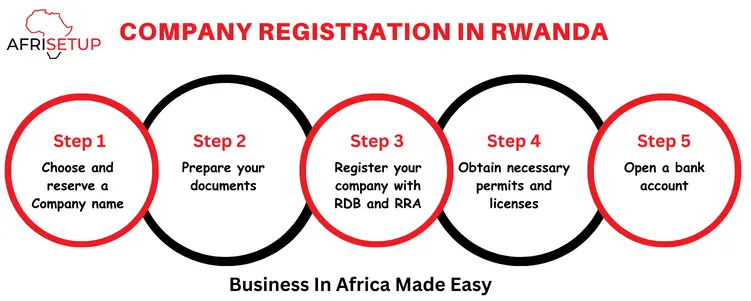
Thanks to a seamless online system, registering a company in Rwanda is now more straightforward than ever. Whether you’re a local entrepreneur or a foreign investor, the Rwandan government provides a digital platform through the Rwanda Development Board company registration system that simplifies the process. Follow these steps for company registration in Rwanda:
Step 1: Choose and Reserve a Business Name
Select a unique name for your company that has not been used in Rwanda. You can check and reserve a business name through the Rwanda Development Board (RDB) website. When making a selection, keep in mind that the Office of the Registrar General in Rwanda will not reserve or authorize a company name if it:
- Violates any Rwandan laws
- Misleads or deceives the public
- Is regarded as insulting or against ethical conduct.
- Is similar to or confusingly comparable to an already registered name
Step 2: Prepare Your Documents
When starting a company, preparing the documents according to the specific requirements to register a company in Rwanda is essential. Here is a checklist to guide you:
- Articles of Association: Official document detailing the company’s objectives, organizational structure, and internal rules.
- Identification Documents: Copies of IDs or passports for all directors and shareholders.
- Proof of Registered Office: Evidence of the company’s official business address.
- Proposed Company Names: A list of three preferred names for the company.
- Share Apportionment Percentage: The allocation percentages of shares among shareholders.
- Business Activities: A description of the company’s main operations.
Step 3: File the application with the Rwanda Development Board (RDB): Send the completed registration forms together with all supporting documents to the RDB. Ensure the required company registration fees and any additional charges are paid. The RDB will then assess the application and verify the submitted documents.
Step 4: Obtain a Certificate of Incorporation
The Rwanda Development Board (RDB) will consider your application after you submit all of the documentation indicated in Step 2 and pay the required fees.
Once the Registrar General confirms that all legal requirements have been met, the office will issue a Certificate of Incorporation within six (6) hours. This certificate proves that your company is officially registered and legally recognized. After acquiring it, your company is entirely founded and can begin activities immediately.
Step 5: Register Your Company with the Rwanda Revenue Authority
After opening a company in Rwanda, you must register for taxes with the Rwanda Revenue Authority (RRA) to facilitate tax payments and business transactions.
Step 6: Obtain Necessary Permits and Licenses
After completing all the necessary processes for company registration in Rwanda, depending on the nature of your business, you may need to seek extra permits and licenses from the relevant authorities.
Step 7: Open a Bank Account
To perform business activities, you must open a bank account for your company. Currently, there are 16 commercial banks from which to choose.
NOTE: Once the Registrar General confirms that all legal requirements have been met, the company is officially registered and added to the register of companies. A certificate of incorporation is then issued, showing the company’s:
- Name
- Registration code
- Company type
- Incorporation date
This certificate serves as official proof that the company has been legally incorporated under Rwandan law. Trust us to help your with business registration in Rwanda.
General Requirements to Register a Company in Rwanda
To register a company in Rwanda, applicants must submit several documents to the Registrar General through the Rwanda Development Board online Portal. The required documents typically include:
- Identification documents for individual shareholders or certified incorporation certificates for corporate shareholders;
- Signed consent letters from the proposed directors or managers of the company;
- Shareholder resolutions or consent letters approving the formation of the company and confirming share ownership;
- The company’s memorandum of association;
- A copy of the articles of association, if applicable; and
- Details of the company’s beneficial owners where required by law.
Requirements for Registering a Foreign Company in Rwanda
Foreign investors can register a business in Rwanda through the Rwanda Development Board (RDB), which provides a fully online one-stop registration platform.
Step 1: Select a Business Structure
The first step is to decide on the legal structure that best suits your business. Rwanda allows 100% foreign ownership in most sectors, making it an attractive destination for international investors.
The most common options are:
- Domestic Limited Liability Company (LLC): A company incorporated under Rwandan law and operating as a local legal entity.
- Foreign Branch Office: A branch established in Rwanda by an existing company incorporated outside the country.
Step 2: Reserve Your Business Name
Before registering your company, search for your preferred business name through the RDB online portal to confirm that it is available. It is advisable to prepare several alternative names in case your first choice has already been registered.
Step 3: Prepare the Required Documents
The documents needed depend on the type of business you are registering.
Domestic Limited Liability Company (LLC)
You will generally need:
- Copies of valid passports for all shareholders and directors.
- Passport-sized photographs of the beneficial owners.
- Details of the company’s intended business activities and shareholding structure.
- A Memorandum and Articles of Association.
- A registered physical business address in Rwanda.
Foreign Branch Office
A foreign company establishing a branch in Rwanda is typically required to provide:
- A notarized Power of Attorney appointing a local representative.
- A notarized Board Resolution approving the establishment of the branch.
- A notarized Certificate of Incorporation from the parent company.
- Copies of passports for the company’s shareholders or directors, with at least one representative residing in Rwanda.
- A notarized copy of the parent company’s Articles of Association.
Step 4: Complete the Online Registration
Submit your application through the RDB’s online registration system. After your application has been reviewed and approved, the system automatically issues and registers:
- A Certificate of Incorporation.
- A Tax Identification Number (TIN) from the Rwanda Revenue Authority (RRA).
- Employer registration with the Rwanda Social Security Board (RSSB) for social security compliance.
Let Afrisetup assist you with with company registration in Rwanda — all from the comfort of your home country.
Post-registration Requirements for Rwanda Company Registration
After successfully registering a company in Rwanda, there are key compliance steps to follow to ensure smooth operations:
a. Tax Compliance: Rwanda’s tax system is well-structured, with mandatory Value Added Tax (VAT) registration for eligible businesses. Ensure timely filing of tax returns to avoid penalties.
b. Business Licensing: Licenses must be renewed periodically. Continually monitor expiration dates to maintain compliance.
c. Employment Obligations: Employers must register employees with the Rwanda Social Security Board (RSSB) and adhere to labor laws to ensure workplace harmony.
d. Employment Compliance: Follow Rwanda’s labor laws regarding contracts, working hours, leave, and employee rights.
e. Annual Returns: File annual returns with the Rwanda Development Board (RDB), which include updated financial statements and company information.
f. Annual General Meeting (AGM): If your business is a public company, hold an AGM as the law requires.
Note for Foreign Companies: Most post-registration steps are the same as for local companies, but some documents, such as a notarized Power of Attorney, certified translations, and a local director, are required during registration. Branches may also be required to submit annual summaries of their parent company’s activities.
Free download
The Rwanda Company Registration Checklist Guide (2026)
Every step, form, document and fee in one printable 2-page PDF plus the foreign-investor essentials (permits, exchange controls, repatriation) most guides leave out.
Types of Companies in Rwanda
Companies registered in Rwanda generally fall into two main categories: public companies and private companies. The classification of a company determines its ownership structure, ability to raise capital, shareholder limits, and compliance requirements. All companies in Rwanda must be registered through the Registrar General’s Office under the Rwanda Development Board (RDB).
1. Public Companies
Public companies are those that have offered shares to the general public, usually through an Initial Public Offering (IPO), and are listed on one or more stock exchanges. These companies are distinct from state-owned enterprises and are subject to the same rules as publicly traded entities.
Key features include:
- They can raise funds from the public by selling shares or debentures.
- There is no restriction on the number of stockholders.
- Shares are generally transferable without limitation.
Companies are treated as public by default until they seek private status through incorporation. For example, Public Limited Companies (PLCs) can list their shares on the stock market and raise funds from various investors.
2. Private Companies
Private companies operate under stricter conditions than public companies. Due to their simplified compliance needs, private companies are frequently chosen by small- to medium-sized businesses and startups. A corporation with only one shareholder is automatically referred to as private.
Key features include:
- A maximum of 100 shareholders.
- Share transferability restrictions imply that shares cannot be freely sold or transferred without prior approval.
- No public invitation to subscribe to shares or debentures.
Under Rwanda’s Law No. 007/2021 of 05/02/2021 on companies, private companies are typically categorized according to their legal liability and organizational structure. The main types of private companies in Rwanda are:
I. Company Limited by Shares: This is a type of company in which the liability of its members is limited to the number of shares they hold. If the company is wound up, the members will only be liable for the unpaid amount of their shares.
II. Company Limited by Guarantee: This is a type of company in which the liability of its members is limited to the amount they have guaranteed to contribute to the company in the event of its winding up. Non-profit organizations commonly use this type of company.
III. Company Limited by Shares and by Guarantee: This type of company combines the features of a company limited by shares and a company limited by guarantee. Its members hold shares, and their liability is limited to the amount of shares they hold. It also has members who have guaranteed to contribute a certain amount if the company is wound up.
IV. Unlimited Company: This is a type of company where the liability of its members is unlimited. If the company is wound up, the members will be liable for all the company’s debts and liabilities.
V. Protected Cell Company (PCC): This type of company can segregate its assets and liabilities into separate cells, each treated as a separate legal entity. This is commonly used in the insurance industry, where each cell can underwrite a different type of risk.
N/B~ According to Rwandan company law, every company is initially considered public unless it states in its incorporation documents that it is private. Understanding these classifications is an important component of satisfying the requirements for Rwanda company registration.
Cost of Registering a Company in Rwanda
Company registration in Rwanda through Rwanda Development Board is free of charge. However, you may incur additional professional costs depending on the type of registration or services required:
- Notarization Fees: If documents such as a Power of Attorney need to be certified, notarization fees usually range from USD 7 – USD 21 (approximately RWF 10,000–30,000) per document.
- Professional Registration Services: Typically USD 150–USD 1,500 (approximately RWF 210,000–2,100,000), depending on the service provider and the level of support required.
Overall, while the government does not charge a fee for registering a domestic company, you should budget for any optional legal, administrative, or professional service costs that may apply. Contact Afrisetup to assist you with Rwanda company registration.
How to check if a company is registered in Rwanda?
Steps:
- Visit the RDB website.
- Select “Enterprise Search.”
- Enter a search term.
- Review the results, including name, number, date, and address.
This process helps ensure that a business has completed proper company registration in Rwanda and is legally recognized to operate.
Can I Complete Rwanda Company Registration Remotely?
Yes, you can register a company in Rwanda remotely. The process is handled by the Rwanda Development Board (RDB). Afrisetup can assist you with the registration.
Tips to Make Company Registration in Rwanda an Easy Process
When registering a company in Rwanda, proper preparation and attention to detail can help ensure a smooth and efficient process:
1. Prepare all documentation in advance to avoid delays.
2. Familiarize yourself with the RDB portal for online applications.
3. Consult industry-specific experts for tailored advice.
4. Double-check all collected information to ensure it is accurate, including passport photos and contact details.
5. Submit scanned copies of all documents, as the system requires electronic versions.
FAQs About Company Registration in Rwanda
Foreigners need a power of attorney, notarized parent company documents, passport copies of shareholders/directors, and a list of directors in Rwanda.
Rwanda is a good place to do business, with stable politics, vigorous growth, and a pro-business environment. It ranks 2nd in Africa for ease of doing business.
No. There is no requirement to have a Rwandan or “local” director.
To dissolve a company in Rwanda, obtain a removal certificate from the Registrar General at the Rwanda Development Board (RDB). This applies if the company is solvent and has no pending creditor claims.
Yes, foreigners can do business in Rwanda without restrictions and are granted the same rights as local investors.
The registration process typically takes 5 to 7 days, depending on the complexity of your business structure and the completeness of your documentation
Rwanda allows wholly foreign-owned companies, though some sectors may have restrictions or require special permits.
Yes. Under Articles 7(4) and 157 of Rwanda’s company law, every company is required to appoint at least one director who is a resident of Rwanda.
Starting a business in Rwanda as a foreigner is straightforward, with a streamlined process conducted online via the Rwanda Development Board (RDB) portal. Simply submit your application and necessary documents through the online platform for efficient processing.
No. With a local representative and notarised documents, the process is completed remotely
A subsidiary is a separate Rwandan entity that limits liability and can convert to a PLC; a branch is an
extension of the parent, which remains liable. Most foreign investors choose a subsidiary
Conclusion
Registering a company in Rwanda is straightforward, thanks to the efficient online registration system and supportive business environment. As trusted experts, we help you navigate each step and ensure you choose the ideal legal structure for your business’s success.
Do you need assistance with company registration in Rwanda? Feel free to contact us to get started.