

- Why Register a Company in South Africa?
- Types of Companies in South Africa
- How to Register a Company in South Africa
- Why Register a Company in South Africa?
Company registration in South Africa is one of the easiest ways for foreign investors to establish a business in Africa’s most industrialised economy. As a member of SACU, SADC, BRICS, and the African Continental Free Trade Area (AfCFTA), South Africa provides access to both regional and international markets. Foreigners can own 100% of a South African company without being residents, and the incorporation process can be completed online through the Companies and Intellectual Property Commission (CIPC) via the BizPortal platform. Once incorporated, investors can generally repatriate profits and capital, subject to South Africa’s exchange control regulations.
The company incorporation process is typically fast, with registrations often completed within a few hours to a few business days after name approval, while the CIPC generally processes applications within 3–7 business days. A foreign-owned company can usually become fully operational within 2–4 weeks after completing tax and other statutory registrations. Whether you are planning a small startup or a large investment, understanding the business registration in South Africa process is essential. This guide explains the different business structures, the CIPC registration process, required documents, registration costs in USD, tax obligations, Special Economic Zone (SEZ) incentives, and the business visa and public officer requirements foreign entrepreneurs should consider before starting operations.
| Authority | CIPC (BizPortal) | Foreign ownership | 100% (no residency) |
| Registration | 3-7 business days | End-to-end | 2-4 weeks (foreign-owned) |
| Corporate tax | 27% (15% in an SEZ) | VAT | 15% (above R1m) |
Free download
The South Africa Company Registration Checklist Guide (2026)
Every step, form, document and fee in one printable 2-page PDF plus the foreign-investor essentials (permits, exchange controls, repatriation) most guides leave out.
Why Register a Company in South Africa?
South Africa offers a stable business environment, advanced infrastructure, and access to regional and international markets, making it one of Africa’s most attractive investment destinations.
Key advantages of choosing to start a business in South Africa include:
- 100% foreign ownership with no residency requirement – Foreign investors can fully own and manage a South African company without living in the country, making it easy to operate remotely.
- Gateway to African markets – As Africa’s most industrialised economy and a member of AfCFTA, SACU, SADC, and BRICS, South Africa provides businesses with access to millions of consumers across the continent and beyond.
- Strong legal and financial systems – The country has well-developed banking services, an independent judiciary, robust capital markets, and strong protection of property rights, giving investors confidence to do business.
- Diverse investment opportunities – Businesses can invest in thriving sectors such as mining, manufacturing, renewable energy, agriculture, financial services, technology, and tourism.
- Government investment incentives – Qualifying businesses may benefit from DTIC grants, research and development (R&D) incentives, and a reduced 15% corporate tax rate for eligible companies operating in Special Economic Zones (SEZs).
- Easy profit repatriation – Foreign investors can repatriate dividends, profits, and capital investments, provided they comply with the South African Reserve Bank (SARB) exchange control regulations.
These benefits make registering a company in South Africa an excellent choice for entrepreneurs and investors looking to establish or expand their business presence in Africa.
The Legal Framework for Registering a Company in South Africa
Company registration in South Africa is regulated mainly under the Companies Act 71 of 2008. This legislation provides the legal foundation for the creation, registration, and operation of companies within the country, including businesses owned by foreign investors. It also outlines the responsibilities and relationships between directors, shareholders, and the company itself. The Act was introduced to encourage accountability, transparency, and good corporate governance while supporting economic growth in South Africa.
The government institution responsible for overseeing company and intellectual property registrations is the Companies and Intellectual Property Commission (CIPC). The CIPC manages several important functions, including:
- Registering new companies and businesses
- Maintaining company and compliance records
- Administering intellectual property registrations
- Enforcing compliance with the Companies Act
Most registration procedures are completed online through the CIPC’s BizPortal platform, making the process faster and more convenient for local and international entrepreneurs.
To successfully complete company registration in South Africa, businesses must meet a few basic requirements, including:
- Appointing at least one director
- Filing a Notice of Incorporation
- Preparing and submitting a Memorandum of Incorporation (MOI)
The Memorandum of Incorporation is a compulsory document that defines the company’s internal structure, shareholder rights, and the responsibilities of directors. It serves as one of the most important legal documents for any registered company in South Africa.
Types of Companies in South Africa
Under the Companies Act 71 of 2008, South African companies fall into two main categories: for-profit and non-profit entities. Each structure is designed for a specific purpose, influencing ownership, funding, compliance, and long-term flexibility. Choosing the right business entity during the process of company registration in South Africa is critical as it directly affects how your business operates and grows.
Below is a breakdown of the five main company types in South Africa:
1. Public Company (Ltd)
A public company (Ltd) can raise capital by offering shares to the public and can be listed on the Johannesburg Stock Exchange (JSE). It requires at least three directors, one shareholder, and a company secretary. It must hold annual general meetings (AGMs) and comply with strict auditing, governance, and disclosure requirements. Registration is done through CIPC, with tax compliance via SARS.
2. Private Company (Pty) Ltd
It operates for profit but does not offer its shares to the public. It requires at least one director and shareholder, but can be founded by one or more individuals. Notably, directors do not have to be South African citizens or residents; unlike public companies, they cannot sell shares to the general public. Registration is mandatory with CIPC using a Memorandum of Incorporation (MOI) and also with SARS for taxes.
3. Personal Liability Company (Inc.)
It is similar to a private company and is commonly used by professionals such as doctors, lawyers, and accountants. It holds directors personally responsible for the company’s debts, creating higher accountability. This structure requires at least one director and one shareholder. Registration with CIPC is required, along with SARS for tax purposes.
4. State-Owned Companies (SOC Ltd)
State-Owned Companies, also known as SOC Ltd, are either entities classified as “state-owned enterprises” under the Public Finance Management Act 1 of 1999 or companies that are owned by municipalities. These companies are primarily governed by the same legal framework as public companies, with most provisions of public company law applying to them as well. Registration with CIPC is mandatory, and tax compliance is handled via SARS.
5. Non-Profit Company
A non-profit company aims to serve the public good rather than generate profit. These entities, formerly known as Section 21(b) companies, must direct all income and assets towards their company objectives and cannot be shared among members or directors.
They require a minimum of 3 directors and can be established by a group of three or more individuals. Also, it requires a clear MOI outlining objectives and governance, registration with CIPC, and may apply for public benefit organization status with SARS.
Choosing Your Business Structure
| Private Co (Pty Ltd) | External Co (Branch) | Representative | |
| Legal status | Separate SA entity | Extension of parent | Liaison only |
| Foreign Ownership | 100% | 100% | n/a |
| Liability | Limited to company | Parent liable | n/a |
| Public officer (SARS) | Required (SA-resident) | Required (SA-resident | n/a |
| Can earn revenue | Yes | Yes | No |
| Best for | Most foreign investors | Extending a parent | Testing the market |
For most foreign investors the choice is between a local subsidiary (Private Company, ‘Pty Ltd’), a branch (external company), or a representative office.
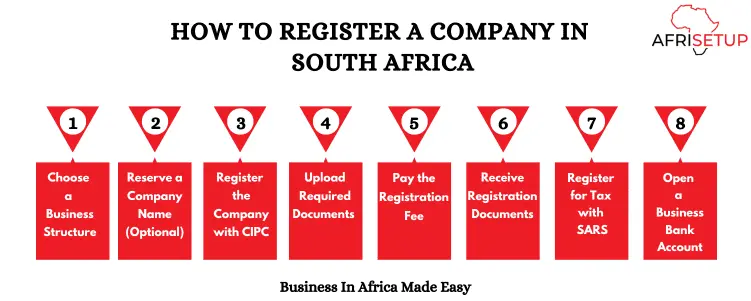
How to Register a Company in South Africa
Below is a step-by-step guide to help you complete your online business registration in South Africa using BizPortal:
Step 1: Create Your BizPortal Account
Go to BizPortal and set up your user profile. Once registered, you’ll be able to access all CIPC functions—including company registration—directly within the BizPortal system.
If you need to look up an existing entity, you can do so through the BizProfile section of BizPortal after logging in.
Step 2: Choose a Business Structure
Select the most suitable option from the different types of companies in South Africa, each with its own legal and operational requirements. Common structures include:
- Non-Profit Company (NPC) – For social or charitable organizations
- Private Company (Pty) Ltd – Ideal for small to medium businesses
- Public Company (Ltd) – Suitable for companies planning to list or raise public funds
- Personal Liability Company (Inc.) – Typically used by professionals like lawyers or accountants
- State-Owned Company (SOC Ltd) – Owned by the government or municipalities
Step 3: Reserve a Company Name (Optional)
Profit companies, eg, private companies, may be registered with or without reserving a name. However, non-profits must have a company name, and the chosen name should be unique and different from existing businesses.
- On BizPortal, navigate to “Name Reservations” and enter 1–4 proposed names with the (Pty) Ltd suffix in order of preference. The system checks availability in real-time and indicates likely approvals. Submit your application and pay the non-refundable R50 fee via credit card or BizPortal customer credit.
- Name review typically takes 1–2 business days, after which you can download the CoR 9.1 or CoR 9.4 certificate from your profile. The reserved name is valid for 6 months (with possible 60-business-day extensions) and should be used promptly during company registration to avoid expiration.
Step 4: Prepare Your Required Documents
Before you begin online company registration in South Africa, ensure you have the official forms and supporting documents required to register a company in South Africa. Here’s what you’ll need:
i. Core Registration Forms (Generated by BizPortal)
- Form CoR 14.1 (Notice of Incorporation) it includes: Company name, Registered address, Share structure (number and type of shares), Initial directors and shareholders, entered via Annexure A, which captures: Full names, Dates of birth, ID numbers or passport numbers, Residential addresses, and Consent signatures.
- Memorandum of Incorporation (MOI). Either the standard MOI (CoR 15.1A) or a custom MOI. This is uploaded if using a custom version.
- Form CoR 19.1 (Founding Statement for a private company)
ii. Supporting Documents for Directors & Shareholders (To Upload on BizPortal)
These documents verify the information that goes into CoR 14.1 and its annexures:
- Certified copies of ID documents or passports for all directors and shareholders (certified within 3 months)
- Contact details (email, mobile number)
- Proof of residential address for each director (if requested)
iii. Supporting Company Documents (To Upload on BizPortal)
These documents provide the evidence required to complete the company information in CoR 14.1:
- Confirmation of company name reservation (if applicable)
- Business physical address (verified via recent utility bill or lease agreement)
- Postal address and email contact
- Financial year-end date
iv. Power of Attorney (if applicable)
Required only if the registration is completed by someone acting on behalf of the incorporator(s).
Step 5: Upload Signed Supporting Documents
You’ll receive a PDF (CoR15.1A) to sign and return. Upload signed forms, certified IDs, and Power of Attorney (if an agent handles registration)
Step 6: Pay the Registration Fee
The cost of registering a company in South Africa varies depending on the type and whether a name is reserved. Fees range from approximately USD 7 to USD 27 (R125 to R475).Please note that this is exclusive of our service charge. Complete the payment via EFT or BizPortal customer credit system, and the quoted fees do not include any additional service charges from third-party providers like Afrisetup.
Step 7: Await Confirmation
After submission, you will receive a tracking number. Often, registration is completed quickly — sometimes within hours after name approval — but depending on name approval, document completeness, and system load, processing may take up to several business days. The CIPC will process your application and notify you of the outcome within 3–7 business days.
Step 8: Receive Registration Documents
If approved, you will receive:
- A company registration certificate (CoR14.3) and MOI via email to prove that your company is legally registered.
- Your company registration number
At Afrisetup, we follow the above step by step process to help both foreign and local investors register a company in South Africa.
Registering a Foreign Company in South Africa
Foreign businesses that want to operate in South Africa without creating a separate local subsidiary can register as an external company with the Companies and Intellectual Property Commission (CIPC). This option is suitable for companies that wish to establish a branch rather than incorporate a new South African company.
A foreign company must register as an external company using Form CoR 20.1 within 20 business days of establishing a business presence in South Africa.
During the registration process, the company will generally need to provide:
- A completed CoR 20.1 application form.
- Certified copies of the parent company’s incorporation documents.
- Details of the company’s directors.
- The registered office address of the parent company.
- The address of its South African branch or business office.
- Details of a South African resident public officer, who will act as the company’s local tax representative.
Once the external company is registered with the CIPC, it must also comply with South Africa’s tax and regulatory requirements, including:
- Registering with the South African Revenue Service (SARS) for corporate tax.
- Registering for VAT, PAYE, and UIF, where applicable.
- Complying with South Africa’s exchange control regulations if capital or profits are transferred across borders.
- Filing annual returns and meeting ongoing statutory and tax compliance obligations to remain in good standing.
Registering as an external company allows foreign businesses to establish a legal presence in South Africa while continuing to operate under their existing parent company, making it an attractive option for businesses expanding into the South African market.
Cost of Registering a Company in South Africa
The official cost of registering a Private Company (Pty Ltd) in South Africa directly with CIPC ranges from USD 7 to USD 10 (approximately R125 to R175). This includes the mandatory company registration fee of R125, with an optional R50 name reservation fee for businesses that want to secure a specific company name. If a name is not reserved, CIPC will register the company using an automatically assigned name linked to its registration number.
Free download
The South Africa Company Registration Checklist Guide (2026)
Every step, form, document and fee in one printable 2-page PDF plus the foreign-investor essentials (permits, exchange controls, repatriation) most guides leave out.
Why Register a Company in South Africa?
South Africa offers a stable business environment, advanced infrastructure, and access to regional and international markets, making it one of Africa’s most attractive investment destinations.
Key advantages of choosing to start a business in South Africa include:
- 100% foreign ownership with no residency requirement – Foreign investors can fully own and manage a South African company without living in the country, making it easy to operate remotely.
- Gateway to African markets – As Africa’s most industrialised economy and a member of AfCFTA, SACU, SADC, and BRICS, South Africa provides businesses with access to millions of consumers across the continent and beyond.
- Strong legal and financial systems – The country has well-developed banking services, an independent judiciary, robust capital markets, and strong protection of property rights, giving investors confidence to do business.
- Diverse investment opportunities – Businesses can invest in thriving sectors such as mining, manufacturing, renewable energy, agriculture, financial services, technology, and tourism.
- Government investment incentives – Qualifying businesses may benefit from DTIC grants, research and development (R&D) incentives, and a reduced 15% corporate tax rate for eligible companies operating in Special Economic Zones (SEZs).
- Easy profit repatriation – Foreign investors can repatriate dividends, profits, and capital investments, provided they comply with the South African Reserve Bank (SARB) exchange control regulations.
These benefits make registering a company in South Africa an excellent choice for entrepreneurs and investors looking to establish or expand their business presence in Africa.
Post Registration Requirements for Company Registration in South Africa
After completing the process of registering a company registration in South Africa, there are several important post-registration requirements that ensure your business remains legally compliant and operational.
a. Open a Business Bank Account
To operate efficiently, your company should open a dedicated business bank account. Most South African banks require the following documents:
- Company Registration Certificate (CoR14.3)
- Memorandum of Incorporation (MOI)
- SARS Income Tax number (or Tax Compliance Status (TCS) PIN, if requested)
- Certified copies of directors’ passports or South African IDs
- Proof of residential address for each director
- Proof of business address (lease agreement, utility bill, or virtual office agreement)
- Work or business visa, if the director is not a South African citizen
Foreign-owned companies may also need to provide additional documents relating to the source of funds and foreign investment compliance.
b. Register for Tax with SARS
Once your company is registered with the Companies and Intellectual Property Commission (CIPC), it is automatically registered for Income Tax with the South African Revenue Service (SARS). However, the company must ensure that its tax profile is active and compliant.
To complete tax registration, SARS may require:
- Proof of identity of directors or the public officer
- Proof of company address
- Proof of bank details
- Company registration documents
If you are not registered for SARS eFiling, SARS may send a manual tax form that must be completed and submitted. Filing annual tax returns is mandatory, as it enables SARS to determine whether your company owes additional tax or qualifies for a refund.
Companies should also appoint a SARS-registered public officer who is resident in South Africa. The public officer acts as the company’s official representative for tax matters and is responsible for ensuring communication and compliance with SARS.
Depending on your business activities and turnover, you may need to register for additional taxes, including:
- Corporate Income Tax – The standard corporate income tax rate is 27%. Companies operating in qualifying Special Economic Zones (SEZs) may benefit from a reduced 15% corporate tax rate, subject to meeting the required conditions.
- Value-Added Tax (VAT) – VAT is charged at the standard rate of 15%. Businesses with taxable supplies exceeding R1 million per year must register for VAT and collect VAT on behalf of SARS.
- Dividends Tax – Dividends paid to shareholders are generally subject to a 20% withholding tax, although this may be reduced where a tax treaty applies.
- Pay-As-You-Earn (PAYE) – Employers must deduct employees’ income tax from salaries and submit these payments to SARS.
- Unemployment Insurance Fund (UIF) – Employers must register and make contributions to provide temporary financial support to employees who become unemployed.
- Skills Development Levy (SDL) – Businesses with qualifying employees contribute 1% of payroll towards skills development and workforce training programmes.
- Customs Duties – Companies importing goods must comply with customs requirements and may be required to pay import duties or related taxes.
- Excise Duties and Levies – Businesses dealing with certain goods, such as alcohol, tobacco, or other regulated products, may need to pay additional duties.
c. Get Sector-Specific Licenses and Registrations
Depending on your industry and business activities, additional permits, licenses, or registrations may be required after the process of registering a company in South Africa.
Examples include:
- B-BBEE Certificate – Often required when applying for government tenders, contracts, or certain funding opportunities.
- Industry-specific licenses – Businesses in sectors such as healthcare, food, finance, transport, and liquor may require additional approvals.
- Central Supplier Database (CSD) Registration – Required for companies intending to supply goods or services to the South African government.
Foreign investors should consider these requirements before starting operations to avoid delays after completing company registration in South Africa.
d. Ongoing Corporate and Compliance Obligations
After incorporation, South African companies must continue meeting annual compliance obligations, including:
- Filing annual returns with the CIPC once every financial year to maintain active company status.
- Maintaining accurate accounting records and financial documents.
- Ensuring proper corporate governance procedures are followed.
- Keeping company information updated with the CIPC when changes occur.
Companies may need to submit additional CIPC forms when making amendments, such as:
- CoR 15.2 – Used to amend the Memorandum of Incorporation (MOI) or change the company name.
- CoR 18.1 – Used to convert a Close Corporation (CC) into a Private Company (Pty) Ltd.
- CoR 39 – Used to add, remove, or update company directors.
e. Exchange Control Regulations for Foreign Investors
South Africa regulates the movement of money into and out of the country through exchange control regulations. Foreign investors should understand these requirements, as they may affect:
- Capital contributions into the company
- Transfers of profits and dividends overseas
- Foreign loans and financial arrangements
Working with a local financial advisor or compliance specialist can help ensure that foreign investments and profit repatriation are handled correctly.
f. Business Visa Requirements for Foreign Entrepreneurs
Non-South African citizens who intend to operate or manage a business in South Africa may require a business visa.
Applicants typically need:
- Proof of investment funds
- A detailed business plan
- Evidence that the business will contribute to the South African economy through job creation or economic activity
Business visa applications are handled by the Department of Home Affairs. Afrisetup can assist foreign investors with business registration, work permits, and visa applications to simplify the process of business registration in South Africa.
Investment Incentives, SEZ Benefits & Support for Foreign Investors in South Africa
South Africa offers several incentives designed to attract local and foreign investment, particularly through Special Economic Zones (SEZs). Qualifying companies operating within an SEZ may benefit from a reduced 15% corporate tax rate compared to the standard 27% corporate tax rate. Other available incentives include:
- Research and Development (R&D) Tax Incentive: Qualifying companies may claim an allowance of up to 150% on eligible R&D expenditure.
- Employment Tax Incentive (ETI): Supports businesses that hire young South African employees by reducing payroll tax costs.
- Capital and Infrastructure Grants: Administered by the Department of Trade, Industry and Competition (DTIC) to support eligible investment projects.
- InvestSA Support: InvestSA acts as a national one-stop shop that helps investors navigate permits, licences, approvals, and government processes for larger projects.
These incentives are not part of the company registration process. Investors must first complete company registration in South Africa through the Companies and Intellectual Property Commission (CIPC), then apply separately for any relevant incentives or investment approvals.
Business Visa, Profit Repatriation & Requirements for Foreign Investors
Foreign investors can own a company in South Africa without living in the country. However, those who want to move to South Africa and manage the business locally must meet additional requirements.
Key points include:
- Ownership vs. Residency: Foreigners can own 100% of a South African company without needing residency. A foreign director who wants to live and work in South Africa must apply for a Business Visa.
- Business Visa Requirements: Applicants generally need to show around R5 million (approximately USD 266,000) in investment capital, create local employment opportunities, and obtain a recommendation from the DTIC. Lower investment amounts may qualify for a waiver depending on the circumstances.
- Public Officer Requirement: Companies must appoint a South African resident public officer for SARS tax purposes. Afrisetup can provide this service for foreign investors registering remotely.
- Profit Repatriation: Foreign investors can transfer dividends and profits out of South Africa, provided they comply with exchange-control requirements managed by the South African Reserve Bank (SARB).
- B-BBEE Compliance: B-BBEE certification is not required to register or operate a company, but a good rating can help businesses access government tenders and larger corporate opportunities.
- Remote Registration: Foreign investors can complete the company setup process without travelling to South Africa by providing the required certified documents and appointing local support where needed.
Company Registration Verification South Africa
Before starting the process of LLC company registration in South Africa, it is important to check whether the business name is already registered. To verify if a company is registered in South Africa, follow these simple steps:
Step 1: Visit the BizPortal Website
– Go to the BizPortal website and log in using your customer code and password.
Step 2: Use the Search Tool
– On the homepage, locate the Enterprise Search tool. You’ll be able to search using the company’s name, registration number, or director’s ID/passport number.
Step 3: Initiate a Search
– Click “Continue to Search”.
– Choose the relevant search criteria (enterprise name, number, or director ID).
– Enter the details and run the search.
Step 4: Review Search Results
– A list of matching enterprises (up to 200) will be displayed. Click on the relevant listing to view more details. The system will show key information like:
– Registration number
– Company status (Active, Deregistered, Liquidated, or only name reserved)
– Director information
Step 5: Obtain Full Disclosure Insights (Optional)
– For a more in-depth view of the business, including its governance structure and historical background, you can opt to purchase a Full Disclosure Certificate for an additional fee.
Note: Ensure you’re logged in, as searches usually require authentication. Some basic name searches may be available without fees.
Feel free to reach out to us for company verification and a company background check in South Africa.
Why Legal Guidance Matters for Business Registration in South Africa
Seeking professional legal support during the process of registering a business in South Africa is highly recommended, especially for foreign investors and businesses with complex ownership structures. While some entrepreneurs attempt to handle the process independently, mistakes during registration can create costly delays and compliance issues.
Some of the common challenges businesses face include:
- Incorrect or incomplete documentation: Errors in submitted documents may result in delays, rejected applications, or additional compliance requirements. Providing false or inaccurate information to the CIPC can also lead to legal consequences.
- Selecting the wrong business structure: Choosing an unsuitable company type can affect taxation, ownership rights, liability protection, and long-term business growth.
- Failure to meet compliance obligations: Many businesses overlook mandatory registrations such as tax compliance, employee-related contributions, and industry-specific requirements, which may lead to penalties or fines.
- Ignoring post-registration responsibilities: Registered companies are required to file annual returns and maintain compliance records. Failure to do so can result in deregistration, invalid contracts, and potential personal liability for directors.
At Afrisetup, we help companies navigate South Africa’s regulatory environment efficiently while ensuring full compliance from the beginning. In addition to handling registration, we also provide guidance on shareholder agreements, corporate governance, licensing, and brand protection.
Who Can Benefit from Company Registration in South Africa?
If you are planning to register a company in South Africa, understanding who can benefit from the process is essential.
a. Foreign Entrepreneurs and Global Business Owners
Register a South African company from abroad and gain access to one of Africa’s leading business markets without the need to relocate.
b. Startups Entering the African Market
Build a recognised legal presence that can help secure partnerships, attract funding, and support long-term business growth.
c. Small and Medium-Sized Enterprises Expanding Abroad
Establish a local branch or subsidiary in South Africa to oversee regional operations, collaborations, and customer relationships.
d. Online Businesses and Digital Brands
Operate within South African regulations, accept local payments, and strengthen credibility with customers in the region.
e. Investment Companies and Holding Entities
Create a legally compliant structure for managing investments, regional assets, and expansion activities across Africa.
f. Independent Professionals and Consultants
Give your business a formal structure, issue professional invoices, and improve access to business banking services in South Africa.
Whether you are a startup, investor, or growing enterprise, Business registration in South Africa can provide the legal foundation needed to expand and succeed in the African market.
Company Registration South Africa FAQs
To verify a company’s registration, use the BizPortal search tool. You’ll need to log in first due to POPIA compliance. You can also use the CIPC’s eServices platform for advanced searches. These tools show the company’s registration number, status, and other key details.
To register a company in SA, you need certified ID copies of directors or incorporators, proof of address, and a chosen company name. You must submit a Memorandum of Incorporation (MOI) and a Notice of Incorporation (CoR14.1) via the CIPC BizPortal. After registration, SARS tax registration is required, along with any applicable industry-specific licenses.
Yes, foreigners can register a company in SA using a valid passport. There are no restrictions on nationality for directors or shareholders, but registration must comply with CIPC requirements, including providing supporting documentation and a local business address. address.
Yes, non-residents can be directors of South African companies. However, they must provide a South African residential address for the directorship. Shareholders do not have the exact requirement and may use an international address.
To apply for a business visa, foreigners must invest at least R5 million in a new or existing business. A detailed business plan and proof of investment are required for approval from the Department of Home Affairs.
Yes, foreign nationals can register a company using a certified copy of their passport. The CIPC accepts this as valid identification, provided all other registration requirements are also met.
Foreign nationals who plan to invest in or start a business in South Africa qualify for a business visa. Applicants must meet capital contribution requirements and submit a business plan showing economic viability and job creation potential.
Under the Turnover Tax system, small businesses only pay tax if their annual turnover exceeds R335,000. This tax replaces multiple standard taxes and simplifies compliance for qualifying micro companies.
Company registration typically takes between 5 days and 5 weeks, depending on the company type, submission accuracy, and the speed at which the required documents are provided. Pty Ltd companies in South Africa are generally the fastest to process.
Yes, a foreign business can register for VAT, but it must appoint a fiscal representative who resides in South Africa. The company also needs a South African bank account for SARS transactions.
Yes. Even if your business is small, you must register it with SARS to get a tax number. You may not pay tax if you earn below the threshold, but registration is still legally required.
Once registered, you should:
- Prepare inaugural board resolutions
- Record the initial shareholder and director decisions
- Open a business bank account
- Register for VAT or PAYE if applicable
These steps ensure your company is compliant from day one.
Yes. South African law allows both locals and foreigners to be shareholders. A company may have just one shareholder, and there are no nationality or residency restrictions for ownership.
Yes, non-residents can open a business bank account, provided their funds originate from outside South Africa. Banks may request proof of the source of funds and supporting registration documents.
Yes. A foreigner can own 100% of a South African company with no residency required – you can
register and manage it from abroad. You must, however, appoint a South-African-resident public officer for SARS.
Conclusion on Company Registration in South Africa
If you want to simplify company registration in South Africa, a fast-track service is the right solution. With expert guidance, you will receive step-by-step support throughout registration, ensuring all your documents are submitted correctly and promptly.
Don’t handle the complexity alone — let Afrisetup help you register a business in South Africa so you can focus on building your business! Contact us today